SOSOIR - Frédérique Hoet, pionnière du design upcyclé
April 2025, Ingrid Van Langhendonck
English translation below
SOSOIR - Frédérique Hoet, a Pioneer of Upcycling Design
April 2025, Ingrid Van Langhendonck
An Artist Grounded in Her Era
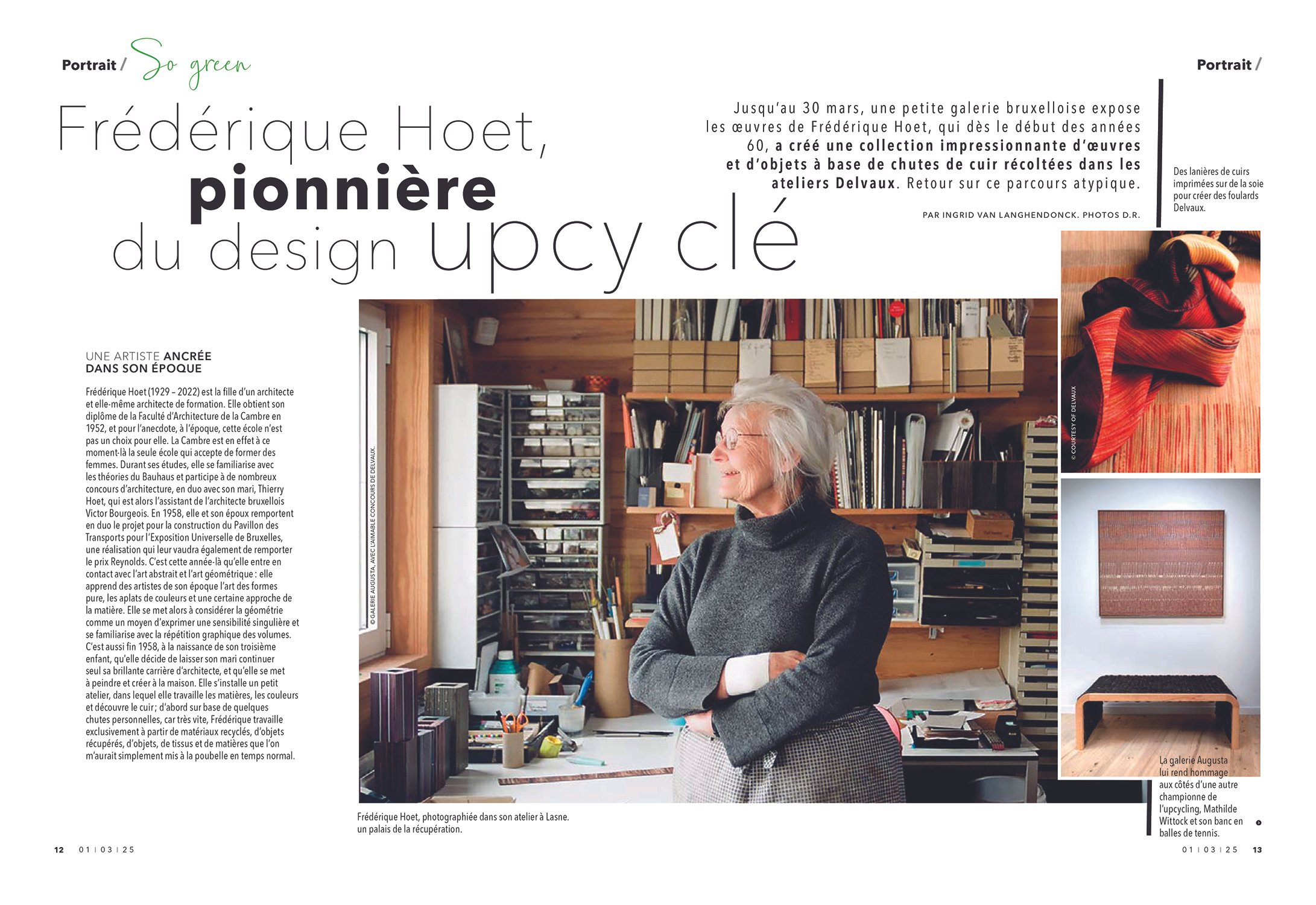
Frédérique Hoet (1929 – 2022) was the daughter of an architect and herself trained as an architect. She earned her degree from the Faculty of Architecture at La Cambre in 1952, and, as a matter of interest, it was not her initial choice at the time. La Cambre was, in fact, the only school that would accept women at that moment. During her studies, she became familiar with Bauhaus theories and participated in numerous architecture competitions, often in collaboration with her husband, Thierry Hoet, who was then an assistant to the Brussels architect Victor Bourgeois. In 1958, the couple jointly won the project to construct the Transportation Pavilion for the Brussels World’s Fair, a project that would also earn them the Reynolds Prize. It was in that same year that she came into contact with abstract and geometric art: she learned from the artists of her time the art of pure form, flat colour fields, and a certain approach to materials. She then began to view geometry as a means of expressing a singular sensibility and became acquainted with the repetitive graphic arrangement of volumes.
It was also in late 1958, with the birth of her third child, that she decided to let her husband continue his brilliant architectural career on his own, and she began to paint and create at home. She set up a small studio where she worked with materials, colours, and discovered leather; initially using a few personal scraps, but very quickly, Frédérique worked exclusively with recycled materials, objects salvaged from the rubbish, fabrics, and materials that would normally have been thrown away.
The Discovery of Leather
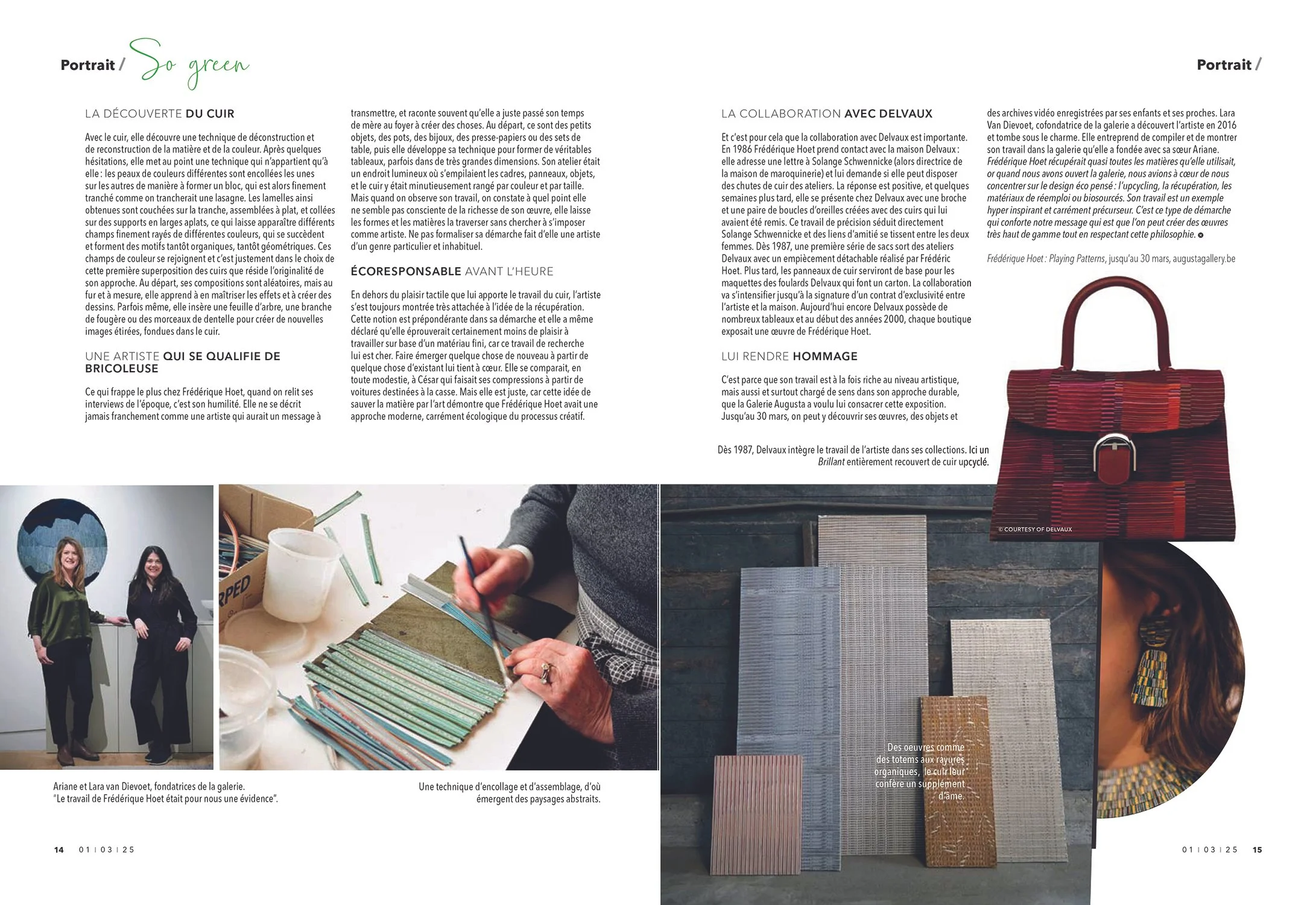
With leather, she discovered a technique for deconstructing and reconstructing both material and colour. After some hesitation, she developed a technique entirely her own: skins of different colours are glued together to form a block, which is then finely sliced like a lasagna. The resulting strips are laid on their sides, assembled flat, and glued onto supports in broad colour fields, which reveal different finely striped fields of varying colours that follow one another and form motifs that are sometimes organic, sometimes geometric. These colour fields merge, and it is precisely in the choice of this initial layering of leathers that the originality of her approach lies. At first, her compositions were random, but gradually, she learned to master their effects and create designs. Sometimes, she even inserted a leaf, a fern frond, or pieces of lace to create new images, stretched and blended into the leather
An Artist Who Calls Herself a “Tinkerer”
What strikes one most about Frédérique Hoet, when revisiting her interviews from the time, is her humility. She never explicitly described herself as an artist with a message to convey and often recounted that she merely spent her time as a housewife creating things. At first, these were small objects—pots, jewellery, paperweights, or table mats—before she developed her technique to produce full-fledged works of art, sometimes in very large dimensions. Her studio was a bright space where frames, panels, and objects were stacked, and the leather was meticulously organised by colour and size. Yet, when one observes her work, one realises just how unaware she was of the richness of her own creations; she allowed shapes and materials to flow through her without seeking to assert herself as an artist. This refusal to formalise her approach makes her a unique and unusual kind of artist.
Eco-Responsible Long Before her Time
Beyond the tactile pleasure that working with leather brought her, the artist was always deeply attached to the idea of upcycling. This concept was central to her approach, and she even stated that she would likely derive less pleasure from working with a finished material, as she cherished the research process. Bringing something new into existence from something already in existence was close to her heart. With characteristic modesty, she compared herself to César, who created his compressions from scraps destined for the scrapyard. And she was right, for this idea of saving materials through art demonstrates that Frédérique Hoet had a modern, downright ecological approach to the creative process.
Collaboration with Delvaux
This is why her collaboration with Delvaux is so significant. In 1986, Frédérique Hoet contacted the leather goods house: she wrote a letter to Solange Schwennicke (then director of the luxury goods company) asking if she could have access to leather offcuts from their workshops. The answer was positive, and a few weeks later, she presented herself at Delvaux with a brooch and a pair of earrings made from the leathers she had been given. This precision work immediately captivated Solange Schwennicke, and a friendship developed between the two women. From 1987 onwards, a first series of bags emerged from the Delvaux workshops, featuring detachable panels created by Frédérique Hoet. Later, the leather panels would serve as the basis for Delvaux scarf designs, which became hugely popular. The collaboration intensified until an exclusive contract was signed between the artist and the house. Even today, Delvaux owns numerous artworks by Frédérique Hoet, and in the early 2000s, each of its boutiques featured one of her works.
Paying Tribute to Her Legacy
It is because her work is so rich artistically, and above all, so meaningful in its sustainable approach, that Augusta Gallery wished to dedicate this exhibition to her. Until 30 March, visitors can discover her works, objects, and video archives recorded by her children and loved ones. Lara Van Dievoet, co-founder of the gallery, discovered the artist in 2016 and was immediately charmed. She set about compiling and showcasing her work in the gallery she founded with her sister Ariane.
Frédérique Hoet reused almost every material she worked with, and when we opened the gallery, we were determined to focus on eco-conscious design: upcycling, salvaged materials, and biosourced or reused materials. Her work is an incredibly inspiring and outright pioneering example. It is this kind of approach that reinforces our message: that it is possible to create high-end works while respecting this philosophy.
Frédérique Hoet: Playing Patterns, until 30 March, augustagallery.be