
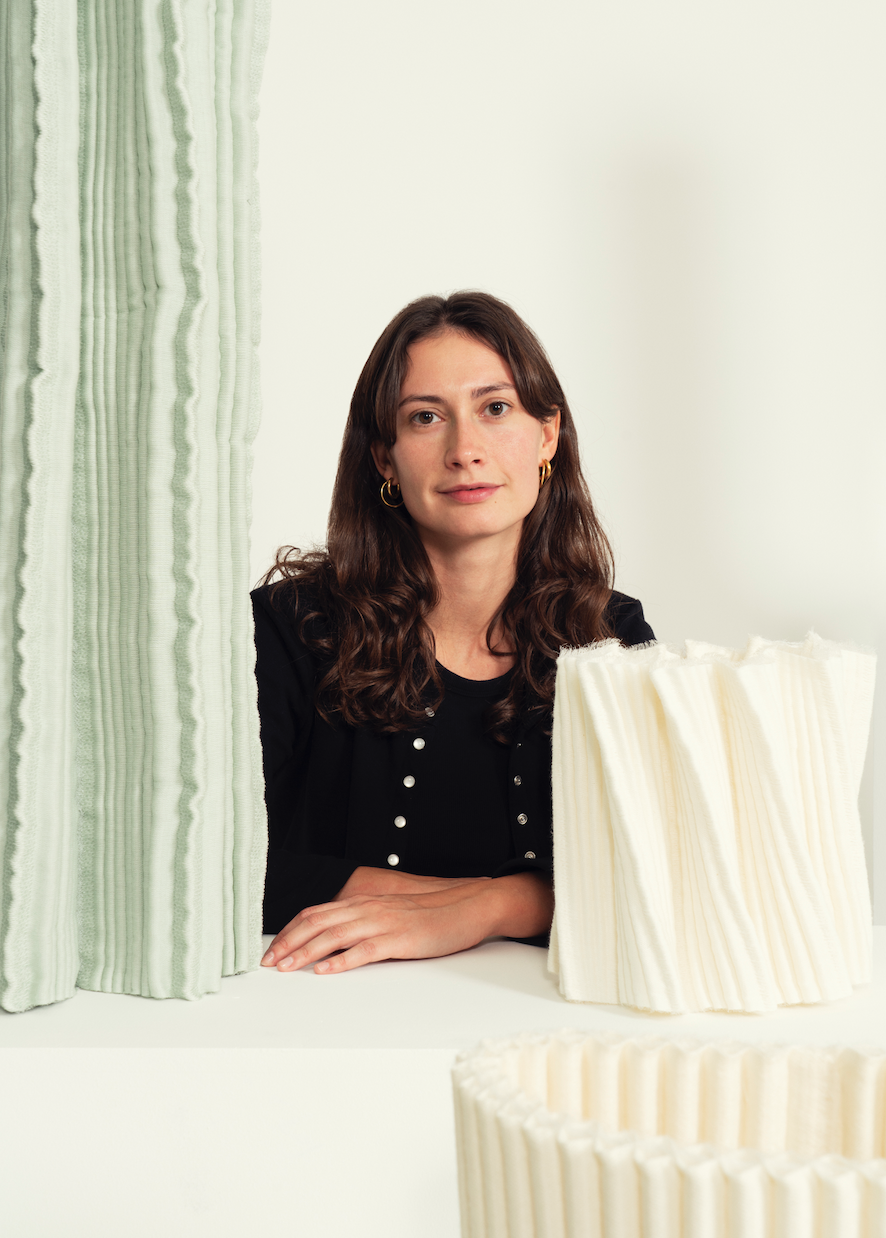
Juliette Berthonneau is a French textile designer. She recently completed her residency at the Bureau du Design, de la Mode et des Métiers d'art in Paris. She works in the development of innovative 3D textile materials for interior design, architecture and art.
She experiments with industrial Jacquard loom technologies to challenge the traditional format of weaving. Juliette explores the poetic relationship between transformable space, human motions, haptic perception and textile behaviors.
Investigating the ability of pleats to structure surfaces, she designs self-standing fabrics. She plays with subtle variations of pattern and color shades according to light and form. She questions contrasts between volume and lightness, as well as solidity and softness. In her project Bouncing Patterns, initiated during her Master’s degree at the Swedish School of Textiles, she develops diverse three-dimensional woven alternatives, that result in unique sculptures along with cutting-edge sustainable solutions for acoustic issues in open spaces, thermal insulation, new mattresses or upholstery materials.
In 2019, Juliette received the Special Jury Mention for the Li Edelkoort Dorothy Waxman International Textile Design Prize of New York. In 2020, she won the Best of Best award from the Ein & Zwanzig competition, and was a finalist of the German Green Product Award. Recently, she won the Belgian Textirama Foundation Concept Award 2021, the French textile design award Vitrine pour un(e) designer and was a finalist of the Wise Women competition 2022.
Juliette is also the winner of the Grand prix de la Création de la Ville de Paris 2023, in the emerging talent design category. In 2024, she was a finalist for the Bourse Dynamo and winner of the Bourse Recherche from ADAGP.
For Soft Assemblies, her first time exhibiting at Augusta, Juliette Berthonneau presents Matin, Midi, Sieste, a collaboration with designer Justine Gaignault.
“We use either a lime-hemp mixture or raw earth. We apply around ten techniques by hand, working almost entirely without machines. After drying, the rough or polished finish reveals its terrazzo-like composition: we call it "earth marble".”
— Nina Ouchinsky, in AMC Magazine