
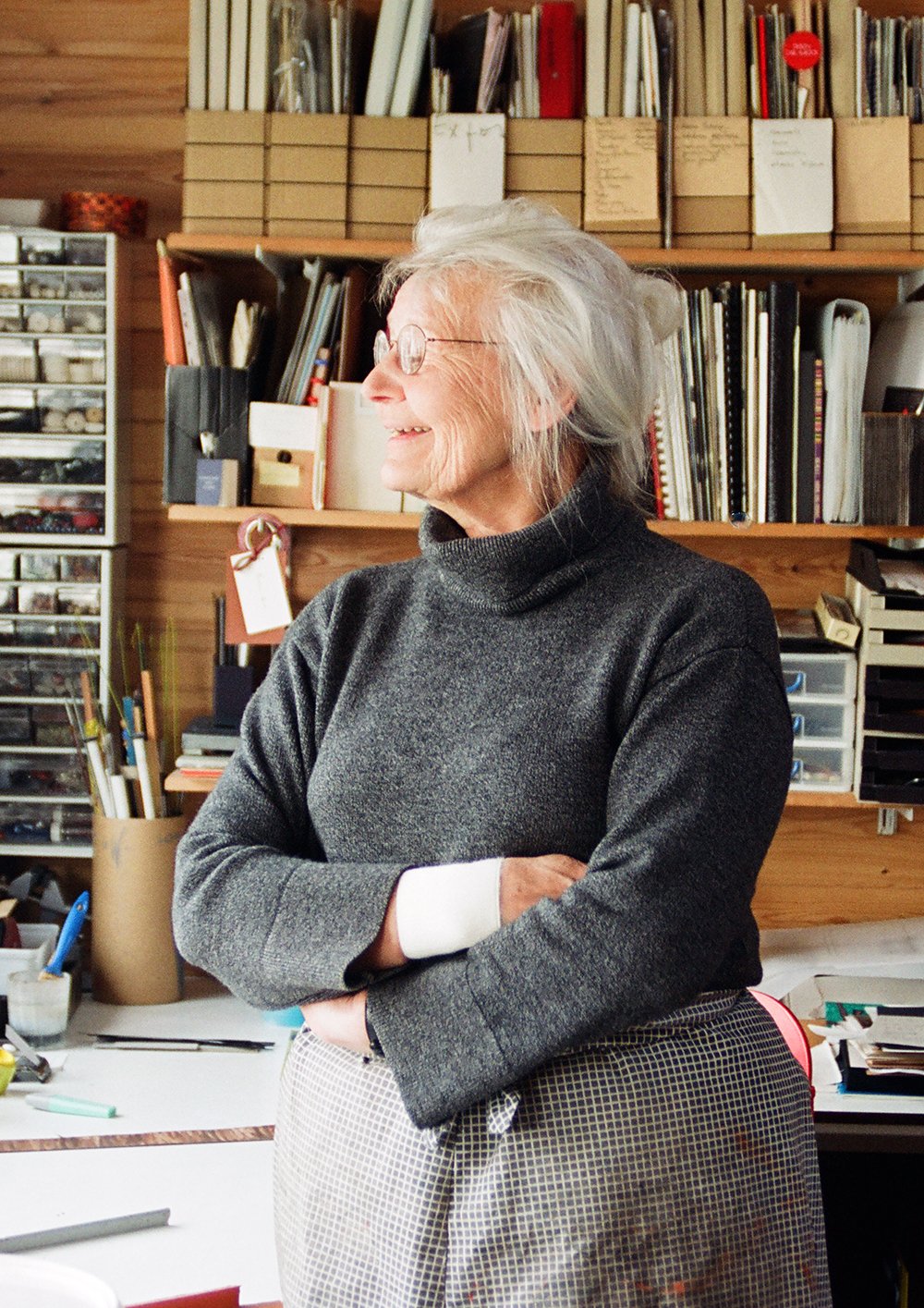
A designer and artist with a background in architecture, Frédérique Hoet-Segers devoted a great part of her artistic career to her leather works, her “Petits cuirs”.
Frédérique Hoet-Segers graduated from l’Ecole Nationale d’Architecture de la Cambre in 1952, with a diploma in architecture and urban planning. She began her career as an architect alongside her husband, Thierry Hoet. As a team, they designed the transport pavilion for Expo 58 in Brussels, for which they won the Prix Reynolds. This period was the foundation of her artistic work and influenced her approach to lines and volumes.
In 1958, following the birth of their third child - the couple would have five - she decided to leave architecture. Unable to stop designing, she began to explore working with used materials and devoted a large part of her work to leather, using scraps that she collected.
It's in a studio set up in the heart of her home in Lasne that she developed her own technique and visual language. The ones who were lucky enough to visit her workshop were amazed by her creativity and the wide range of her work with leather.
The artist’s collaboration with Delvaux, which began in 1986, led to the creation of limited-edition bags and lines of scarves and accessories. "One day, I wrote to Delvaux to ask if I could get hold of some scraps of leather, the kind we usually throw away," explained Frédérique Hoet-Segers in 2001. She then received large bags containing pieces of leather from the workshop. To thank Solange Schwennicke, then Head of la Maison Delvaux, she showed her her creations. This sparked her long-term collaboration with the brand.
The following year, 1987, saw the launch of a first collection of bags (pictures available on demand). A few years later, la Maison Delvaux proposed to use her work for a new collection of scarves. Her compositions were reproduced and printed on silk. Umbrellas, ties and bobs were also created from her designs.
“My work is a game of cutting and pasting. First I glue together leather samples of all colours. Then I make the cuts. Some pieces are cut several times. In the end, I put it all together. When it’s finished, I don’t think about it any more, I move on to something else.”
— Frédérique Hoet-Segers, 2001


By Frédérique Hoet-Segers
Chromatic array showcases examples of the way Frédérique Hoet-Segers assembled strips of leather in a structured yet unexpected way to create patterns and geometrical landscapes. Augusta selected works from the designer’s archives, demonstrating the strength of her technique and the diversity of her composition : wall pieces, jewellery and objects created from leather scraps.
wall panel
«Petits cuirs»: leather scraps cut and assembled by the artist
55 × 38.5 cm
made in Lasne
This piece is unique, please contact us to place your order so we can guarantee availability.
UNIQUE PIECE - PLEASE EMAIL US