
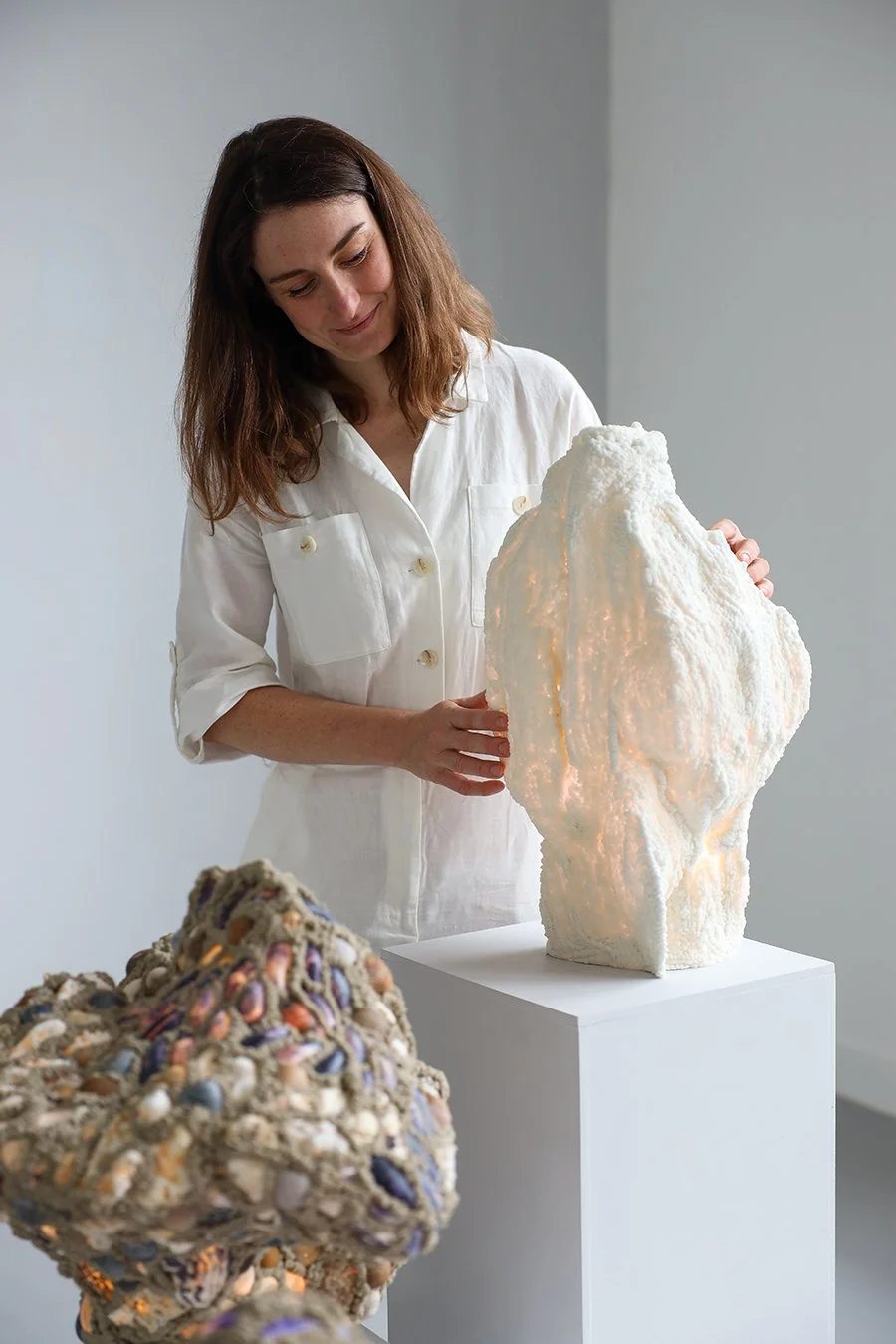
Agnieszka Mazur is a designer, sculptor, and material researcher who crafts extraordinary, handcrafted sculptures that seamlessly blend art and functionality. Through her independent practice, Studio Mazur, established in 2018, she redefines home aesthetics and weaves rich narratives through material and form to evoke emotion and unleash the imagination.
Central to her practice is a "thinking through making" methodology, where materials serve as primary vehicles that enable and drive her research. Mazur questions and investigates the cultural meanings assigned to materials and the storytelling they are enveloped in, asking: What can materials tell us about reality? Rather than relying solely on existing techniques, she frequently develops her own tactile processes, allowing the answers to organically emerge from the materiality of the process itself.
Mazur’s work often engages with notions of the hidden, the discarded, the neglected, and the obvious—elements that, through their sheer proximity to daily life, act as sensitive barometers of our reality. Driven by the belief that we must challenge our standard perceptions, definitions, and common understandings to look past the surface of the everyday, her professional practice remains a meditative, deeply felt dialogue with her chosen mediums.
Based in the Netherlands, Mazur earned a Bachelor’s degree in Design from the Academy of Fine Arts in Warsaw and a Master’s degree in Contextual Design from Design Academy Eindhoven (2017). Her practice has been recognized with two prestigious grants from the Creative Industries Fund NL (2019, 2022) and the "Młoda Polska" (Young Poland) scholarship from the Minister of Culture and National Heritage (2013). Most recently, she was named a finalist in the Kunszt Competition, supported by the Starak Family Foundation in Poland.
For her upcoming participation in Soft Assemblies at Augusta Gallery, Agnieszka Mazur will debut a new series of works created in close collaboration with the gallery. The Dunes lamps are made of sand reclaimed from a waterjet cutting process in a Brussels’ fablab.
“We use either a lime-hemp mixture or raw earth. We apply around ten techniques by hand, working almost entirely without machines. After drying, the rough or polished finish reveals its terrazzo-like composition: we call it "earth marble".”
— Nina Ouchinsky, in AMC Magazine